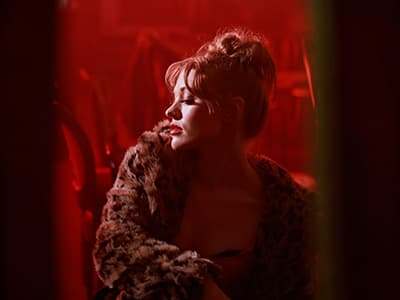
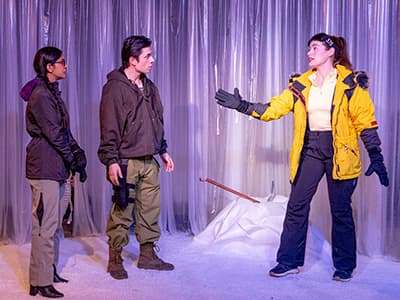
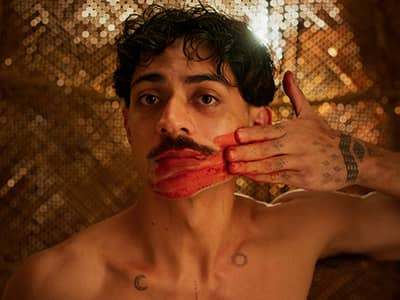
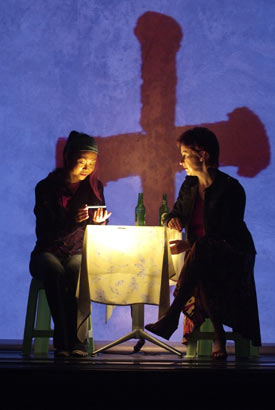
 Left - Tai Wei Foo and Marie Michaud. Cover - Marie Michaud and Tai Wei Foo. Photos - Louise Leblanc
There is a Chinese legend in which babies who cannot be kept by their mothers, such as those born out of wedlock, are placed in the river. Which of The Three Gorges the current carries the baby down to will determine the fate of that child. Down to the first gorge and the baby will be found by a family who can raise it. Down to the second and the baby will die. Should the baby be carried down to the third gorge, the baby will end up back where it came from. It means that even the outcome that promises any real future for the child will bring about incredible pain and loss.
In present day Shanghai and Robert Lepage’s The Blue Dragon, China’s ancient mythology, traditional values, and art, are meeting head on with the contrasting modern technology, media, and expression of Western culture. It is a curious, and complex tug-o-war.
Lepage and his co-writer Marie Michaud have presented this sequel to The Dragons’ Trilogy through Pierre (Henri Chasse), a Canadian who now runs a gallery in Shanghai. Though Pierre has lived in China for a number of years and is beginning to absorb, and exist in, the more traditional ways of Chinese life, his point of view is still that of an outsider, a traveller to a country that even to himself, is still not fully understood.
The Blue Dragon is like a film come to life, and there are many moments when one has no choice but to simply be mesmerised. Integral to this is David Leclerc’s projection of film and images and the employment of a technique that allows the performers to construct the imagery live, through the placement of their bodies. It allows for instance, Chasse to paint Pierre’s Chinese calligraphy on the floor-to-ceiling wall behind him, the ink seemingly appearing from a giant brush. This use of infrared lighting and cameras to follow the movement of the performers and relay it back to a computer for projection is a technique that Lepage used in his creation of Metropolitan Opera’s La Damnation de Faust. Australia’s own Chunky Move used it similarly in their show Mortal Engine. The result is art that is spontaneous, immediate, and a direct extension of the human form.
Michel Gauthier’s multi-layered set, composed largely of moveable screens and floors, is striking rather than fussy and yet Gauthier’s attention to detail especially on a smaller scale provides some of the most surprising and delightful moments in this work. It also allows for seamless scene changes, which, in combination with Louis-Xavier Gagnon-Lebrun’s lighting, take us between the contrasting environments of Pierre’s warehouse home with its Chinese influence, to the hectic and impersonal setting of the airport and train station, even a city bar.
Pierre’s existence in the emotional void somewhere between China and his native Canada is compounded and highlighted by the plays’ other two characters. Claire (played by Michaud), an advertising executive from Montreal whom Pierre knew many years ago at art school, has come to China to visit Pierre and adopt a Chinese baby. She is sceptical of his departure from the Western lifestyle and, at least at first, of Xiao Ling (Tai Wei Foo), a young Chinese artist exhibiting at Pierre’s gallery. Ultimately it is Xiao Ling’s own entrapment between the power of her country and the life she would like to lead that has the greatest effect on these characters. The heated arguments between them, and in particular the developing relationship between Xiao Ling and Claire, are wonderful to watch. Chasse and Michaud are evidently experienced performers; Michaud’s sense of timing is especially vivid. Tai Wei Foo, in her first acting role, also delivers, and not only with her display of dance.
Due to the clash of languages between the three characters, The Blue Dragon is told in a combination of English, French and Chinese. Again, as if placed in a film, the French and Chinese lines are accompanied by English subtitles that are projected on a beam that is placed towards the top of the towering set. The few occasions when the subtitles are obviously out of sync with the dialogue of the performers is a little jarring, but is easily soon forgotten.
The historical and political influences, the actual motivations of each of the characters, although present, are often only hinted at. Perhaps this is because, as outsiders, or travellers, our view of China, our knowledge and understanding of it, and its complexities, can only ever be rather superficial. Despite this The Blue Dragon creates the feeling that when these cultures unavoidably collide, they will forever leave their mark on each other; be they etched in ink on the skin like the dragon tattoo, be it through the birth of a child, or through the loss of a loved one. It provokes and expresses the emotion and mood that seems to be being squeezed out of the very environment it presents and just as powerful as it is magical, the audience can become delightfully lost within it.
And so comes the time when the audience is quite content to have the play tell them how it all ends. Instead, Lepage dares his audience to choose their characters’ futures. In terms of an ending, the play offers up three. Perhaps in reality, it isn’t our place to conjure up or suggest an ending that is nice, or even fitting. Perhaps it isn’t even really possible.
2010 Melbourne International Arts Festival
The Blue Dragon
Robert Lepage
Venue: the Arts Centre, Playhouse
Dates/Times: Fri 8 – Sat 9 Oct & Mon 11 – Tue 12 Oct at 8pm, Sat 9 Oct at 2pm, Sun 10 Oct at 6pm
Duration: 1hr 45 min no interval
Tickets: $75 - $25
Bookings: the Arts Centre 1300 182 183 | www.theartscentre.com.au | Ticketmaster 1300 723 038 | www.melbournefestival.com.au
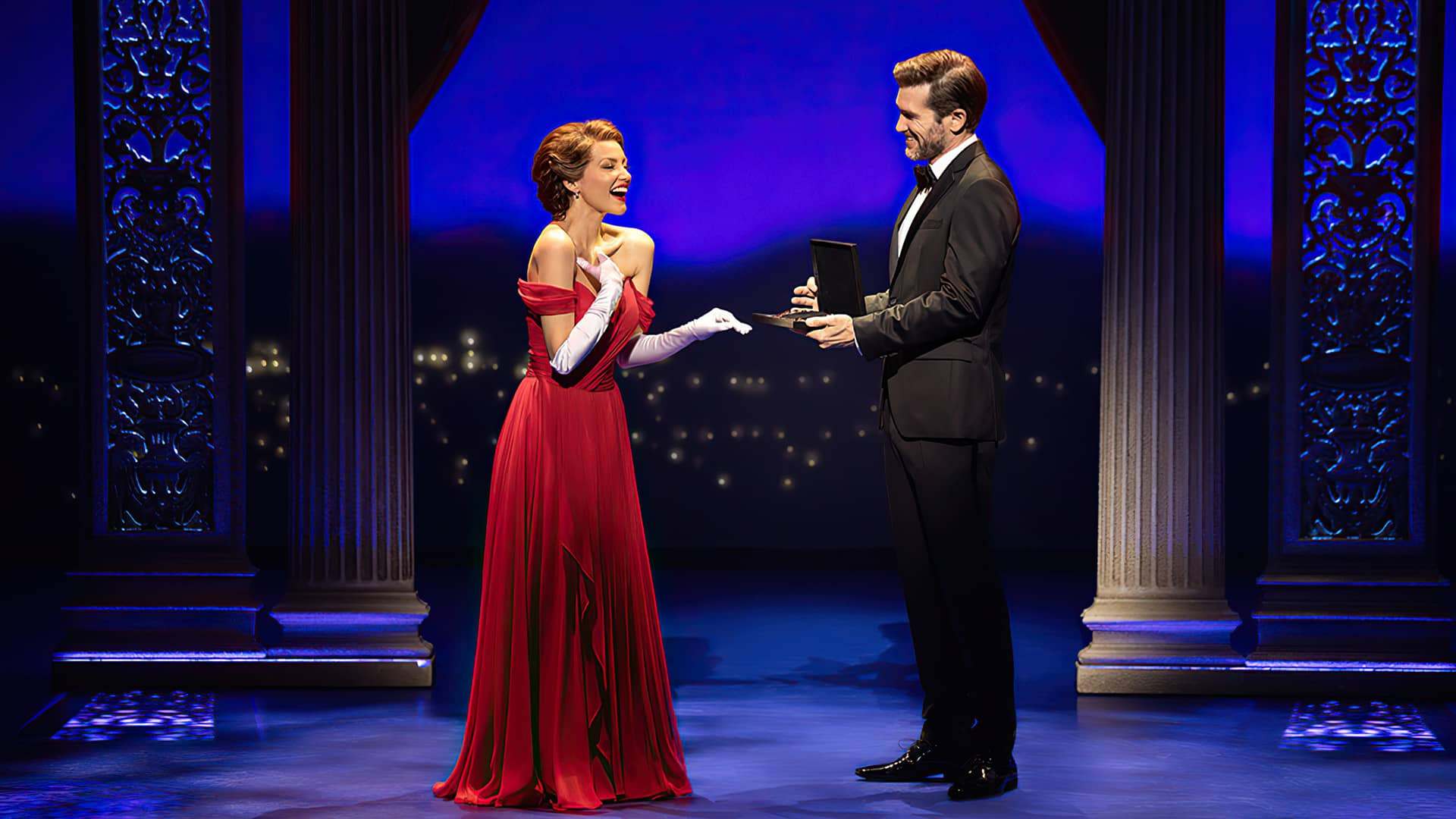
Adapting a beloved film with the cultural status of 1990s Pretty Woman is a huge creative swing.
20 July 2026
Melbourne
11 July 2026
Canberra
9 July 2026
Sydney
10 July 2026
Canberra
26 June 2026
Melbourne
Latest Reviews
The Blue Dragon | Robert Lepage
- Details